


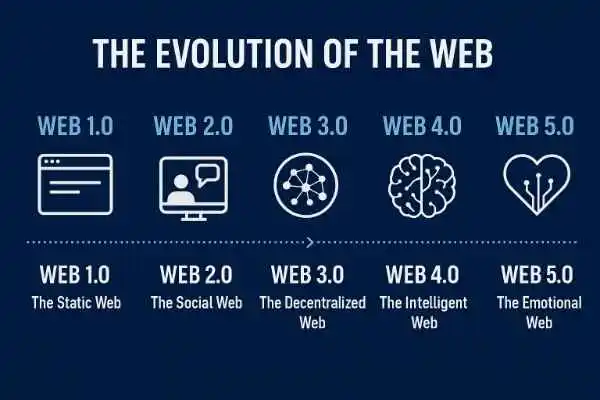
The evolution of the web has been continuous. The internet has transformed the way we live, work, and connect with each other. Over the past three decades, the web has gone through multiple evolutionary stages – each bringing new possibilities and challenges.
From the static pages of Web1 to the intelligent, emotionally aware web of the future (Web5), let’s explore how far we’ve come and where we’re heading.


Web1.0 – The Static Web (1990s)
- Definition: The first version of the internet, often called the “Read-Only Web.”
- Technology: Static HTML pages, simple hyperlinks, dial-up connections.
- User Role: Consumers of information.
- Examples: Early websites like Yahoo Directory, personal homepages, and Netscape.
Key Characteristics –
- Limited interaction
- No user-generated content
- Businesses had digital brochures rather than interactive platforms
Web2.0 – The Social Web (2000s)
- Definition: Known as the “Read-Write Web,” Web2.0 introduced dynamic content, social interaction, and collaboration.
- Technology: JavaScript, AJAX, and improved broadband.
- User Role: Content creators and participants.
- Examples: Facebook, YouTube, Twitter, Wikipedia.
Key Characteristics –
- Social media boom
- Blogs, wikis, forums
- Centralized platforms controlling user data
- Monetization through advertising
Web3.0 – The Decentralized Web (2010s)
- Definition: The “Decentralized Web,” powered by blockchain and focused on user ownership and privacy.
- Technology: Blockchain, smart contracts, decentralized apps (dApps).
- User Role: Owners of digital assets and identities.
- Examples: Ethereum, IPFS, NFTs, decentralized finance (DeFi).
Key Characteristics –
- Peer-to-peer transactions
- Data ownership and control
- Trustless systems (no intermediaries)
- Rise of cryptocurrencies and digital tokens
Web4.0 – The Intelligent Web (2020s and Beyond)
- Definition: Often called the “Symbiotic Web,” Web4.0 integrates AI, IoT, and brain-computer interfaces (BCIs) for a seamless, predictive user experience.
- Technology: Artificial intelligence, machine learning, natural language processing, immersive AR/VR.
- User Role: Active participants with personalized, predictive digital environments.
- Examples: AI assistants like ChatGPT, smart cities, brain-machine interfaces.
Key Characteristics –
- Personalized, predictive, and immersive experiences
- Internet of Things (IoT) connectivity
- Emotion-aware interfaces
- Digital agents acting on behalf of users
Web5.0 – The Emotional Web (Future)
- Definition: The next frontier, sometimes described as the “Emotional Web,” where the internet understands and responds to human emotions.
- Technology: Advanced AI, affective computing, neurotechnology.
- User Role: Symbiotic partners with machines.
- Examples: Future AI systems capable of empathy, immersive metaverse experiences.
Key Characteristics –
- Emotionally aware AI
- Deeper human-machine trust
- Hyper-personalized experiences
- Ethical challenges around neuroprivacy
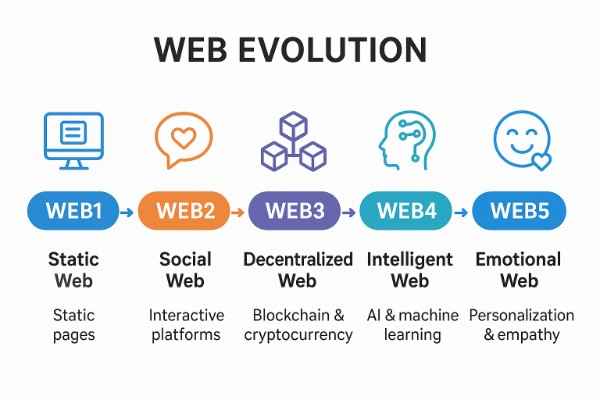
Comparison of Web1 – Web5
| Feature | Web1.0 (1990s) | Web2.0 (2000s) | Web3.0 (2010s) | Web4.0 (2020s+) | Web5.0 (Future) |
|---|---|---|---|---|---|
| Nature | Static | Interactive | Decentralized | Intelligent & Predictive | Emotional & Symbiotic |
| User Role | Consumer | Creator | Owner | Participant + Collaborator | Partner with AI |
| Technology | HTML, HTTP | JS, AJAX | Blockchain, dApps | AI, IoT, BCI, AR/VR | Affective AI, Neurotech |
| Example Platforms | Yahoo, Netscape | Facebook, YouTube | Ethereum, OpenSea | Smart homes, AI assistants | Emotional AI, Future Metaverse |

Frequently Asked Questions (FAQs)
What is the main difference between Web2 and Web3?
Web2 is dominated by centralized platforms (Facebook, Google), while Web3 gives users control through decentralization, blockchain, and ownership of digital assets.
Is Web4 already here?
Yes, elements of Web4 (AI assistants, smart cities, IoT) are already emerging. However, a fully symbiotic and predictive web is still in development.
What makes Web5 different from Web4?
Web4 is about intelligence and prediction, while Web5 goes a step further – adding emotional awareness, empathy, and deeper human-machine integration.
Who coined Web5?
The concept of Web5 gained traction through Jack Dorsey’s vision of combining Web2 and Web3 principles, but futurists use it to describe the emotional web as well.
The Future of the Web
From static pages to intelligent ecosystems, the web continues to evolve at lightning speed. Web4 and Web5 promise a future where the internet is not only smarter but also more human-centered.
Businesses, developers, and users need to prepare for this transformation by embracing AI, decentralization, and ethical digital practices.
The journey is far from over – if anything, it’s just beginning.